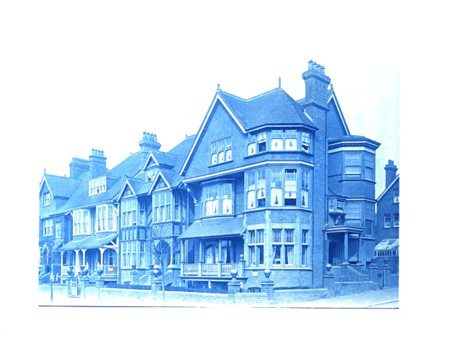
Here you have a book I wrote on a deeper study on how Albert Levy contributed to develop Architectural photography, specially in the United States.
Download pdf:
- Any copy and/or distribution is not allowed without written permission
- Howerver, feel free to reference any text within. Please mention "Alonso Robisco collection" as your reference. A link to this web (thecollection.alonsorobisco.es) would be appreciated.

See some relevant parts:
Full index:
1.1. Abstract
1.2. Albert Levy
2. A personal view on Albert Levy’s photographs
3. Describing the pictures
3.1. Structure of Albert Levy’s photographic albums
3.2. Selecting the mansion
3.3. L’Architecture Americaine
3.3.1. The Twin Houses. New York
3.3.2. Cornelius Vanderbilt Residence (I). New York
3.3.3. Cornelius Vanderbilt Residence (II). New York
3.3.4. Samuel Tilden Residence. New York.
3.3.5. Ogden Goelet Residence. New York.
3.3.6. James Converse Residence. Edward Hopper’s style. Boston
3.3.7. Augustus Byram Residence. Chicago
3.3.8. Weelock and Clay building. Chicago.
3.3.9. John E. Bell Residence. Cincinnati.
3.3.10. Robertson building. New York
3.3.11. The Berkshires. New York.
3.3.12. S. M. Nickerson Residence. New York.
3.4. Villas et Chalets pittoresques.
3.4.1. Villa Honore. Trouville.
3.4.2. Victor Lecesne Maison. Beuzeval.
3.4.3. Baumier (father) building. Houlgate
3.4.4. Leroux et Bitner and F. Duchemin building. Villers
3.4.5. E. Singery building. Houlgate
3.4.6. Maison Les Mouttes. Houlgate
3.4.7. Baumier and Lewicki Building. Houlgate
3.4.8. Villa Pibola. Cabourg.
4. Understanding the importance of Albert Levy in the history of American architectural photography.
5. The complete biography
Extracts:
[...]
Selecting the mansion
The criteria for selecting a mansion depends on the architect of the building, and that is the way it is expressed in the index of the album. Obviously, the fact of selecting a house depended on the architect. This usually meant that their owners had to be rich and powerful people living in the best locations of each city. Consequently, Albert Levy was taking pictures of the present, the present that the photographer thought that was going to last for ages according to the quality of the author.
The difference with other photographers of his time is that others wanted to show the life in the city or a complete vision of it but Levy focused of some buildings of big importance.
[...]
Understanding the importance of Albert Levy in the history of American architectural photography.
The history of American Architectural Photography started with the daguerreotypes in 1840. There were many important photographers that took part of this history. Here we can list some of the key ones, indicating its time and its location in a chronological order, so we can understand the situation of Levy’s work among them, and its importance.
- Daguerrotypes and stereocopes of Southworth and Hawes. c.1843. Boston.
- Daguerrotypes by Robert H. Vance. San Francisco.
- Fred Coombs. San Francisco
- John K. Pumble. Washington and New York.
- Victor Prevost. New York.
- G. R. Fardon. San Francisco
- Edward Anthony: “Anthony instantaneous views of New York”. 1859.
- Carleton Emmons Watkins. San Francisco. Yosemite.
- Mathew Brady New York
- Theodore Lilienthal Portfolio New Orleans.
In 1860, Gustave Le Gray’s work and also the work from his colleagues of the Mission Heliographique’s began to be known and much appreciated for the photographers. These professionals saw a new way of taking pictures of the cities and their elements isolated from the rest of the components of the city. Buildings, churches as well as partial details of them were the main part of the image.
In the beginning of the 1870’s we have data that confirms that Albert Levy started working in New York. When he arrived to New York, he already was a professional photographer with a European point of view for his pictures that focused in particular views of the buildings rather than the view of the whole city. His work will lately spread throughout the United States taking pictures of New York, Chicago, Boston, Philadelphia, Detroit, Albany, Baltimore or Cincinatti.
In these cities, he developed his architectural photography in a very systematic way:
- Public Buildings
- Private residences
- Suburban homes
- Churches
- Interiors
So, in order to appreciate the size of his work, we now know that he made more than 200 photographs only of the city of New York, becoming one of the biggest photographic archives of those ages. If fact, we can suppose that his studio in Pine Street, in New York, where “Albert Levy’s Architectural Photographic Series” started. It is quite probable that the price of his photos was the reason for his work to be so scarce nowadays.
If we compare Albert Levy to the important photographers listed above, the facts are that:
- Albert Levy did more architectural photographs than anyone in the 1880’s or before. He made 2.500 photos, 600 of them of the United States. The Mission Heliographique made “only” 250.
- Albert Levy had a catalogue with his work made by himself in 1887. None of the above has.
- Albert Levy worked in Europe and the United States. None of the above had a bookshop at both side of the Atlantic Ocean at the same time to sell their photos.
- Albert Levy’s pictures identify the owner, the architect and the location of the house. None of the above does, and he even had a catalogue to classify his work.
- Albert Levy worked in 9 different countries. None of the above did.
Albert Levy, thank to this series, will be the introducer of American Architectural Photography in Europe. In this catalogue, that is in the Biblothèque Nacional de France (BnF), we can read a list of more than 600 photographs of the United States on sale in 1880’s.
Apart from this, as photographers did those ages, Levy also sold his photos to publishing companies. This is the origin of the album “L’Architecture Americaine” that is a compilation of pictures sold to the publishing company Andre, Daly fils et cie. , the most important publishing house about architecture in Paris. Its 120 photos are the best of Albert Levy’s catalogue from the United States.
Finally we have to highlight that during the research, we have found that Albert Levy’s work is in many libraries and American museums, but it is very difficult to find in Europe. We have only found the complete “L’Architecture Americaine” (the set of three albums) in Munich. Neither the BnF has a complete album, only some pictures from his last studio in Paris.
We are in front of an elusive but very important architectural photographer, perhaps a little better known now.