There are several references in XIX century magazine "The Philadelphia Photographer" and in the "Photographic Times" explaining Levy's French Emulsion (also known as Levy emulsion). These references weere published one year before Eastman's patent.
- Philadelphia Photographer May 1878 vol XV nº 173
- There is a long article explaining the benefits of Albert Levy's dry plates, at least one year before George Eastman's invention. In 1879, Eastman invented an emulsion-coating machine which enabled him to mass-produce photographic dry plates, patented in 1880 (see pdf).
-
Levy's French Photographic emulsion
LEVY'S FRENCH PHOTOGRAPHIC EMULSION.
A GOOD deal of interest prevails in the growth of the emulsion processes, and the practical photographer is waiting patiently until some one develops a method for working emulsion sufficiently certain, reliable, and speedy, to warrant its introduction into every-day practice, or, in common parlance, that will be " as good as wet." A number claim to have attained this great result, but we believe none have yet been found who have done so fully. There is one gentleman, however, Mr. Albert Levy, of New York, to whom much credit is due for having made great progress with emulsion, and who, so far as we know, more progress than any one else. He has simplified the manipulation so much that it is quite as easy as the "wet process;" he has reduced the time of exposure very greatly, and claims that his emulsion does not change readily, and that it works uniformly the same. With these assurances we have made a few experiments with Mr.Levy's emulsion, with plates wet and dry, both for portraiture and landscape work, and lantern transparencies.
These experiments being few, as we have said, we do not consider ourselves capable yet of passing full judgment. But this much we are prepared to say, namely, that we are impressed with the ease and simplicity of the process, on account of the very few manipulations required, of its certainty in every respect, and of the excellence of the results Of the quickness of the emulsion, we cannotsay that it is equal to the wet collodion process with the nitrate bath. It is slower.
As to this, we shall have more to say here-after. What we have said is to encourage others to make trial, and experiment with us to perfect a process that, when perfected, will be an endless source of convenience and comfort to every photographer, and that long hoped-for result will be accomplished, namely, the ability to make work without the nitrate bath, equal to that made with it,in the same time.
We append Mr. Levy's process, that all who desire may experiment as suggested, and will be glad to offer our services, and those of Sphynx, to aid them.
Shake up the emulsion well an half hour before using, and flow the plate slowly in the dark-room. As soon as set, immerse in water and let remain until no greasiness of surface is present, though a longer time doesno harm. The plate can be exposed in the camera at once. If so used, let dry for a few seconds, wipe the moisture (and mark of pneumatic holder, if used) from back, andplace in shield and expose in camera. If,on the other hand, the plate is intended forfuture use, place it, on removing it from thewater, in the preservative, and let it remain
there from three to five minutes. On removing it let it drain well ; wipe off theback, and stand on end on blotting-paper or drying-rack in the dark-closet until dry,when it can be put away in the negative box for use when wanted. Plates so pre-served will keep indefinitely.
On removing the shield from the camera, after exposing a plate (either wet, as first noticed, or dry, as it is termed when preserved), take it in the dark-room and immerse the plate in water for a few seconds if wet, longer if dry, and on removing flow over some developer mixed with pyrogallic acid, two or three grains to the ounce.
Carbonate of Soda, 1 ounce.
Bromide of Ammonium, . 80 grains.
Honey (teaspoonful), 1 drachm.
Water, .... 1 pint
The image will appear at once and gain full printing density, if the exposure has been right, without any further means, and with perfect freedom from fog.
If fearing overexposure, dilute the developer one-half with water, and proceed as before, and then, on finding such is not thecase, pour off and strengthen by adding more, or pour off" and use it without any dilution. This gradual development is by many much used (although not equally productive of intensity), for by it the choicest gradation of tone and perfection of negative may be secured.
The development finished, wash and fix,by immersing in hyposulphite of soda, one pound, water, two pints, and when all traces of the white or unaffected portions of the film have disappeared, wash well and thoroughly under tap and place on shelf to dry.
When dry, varnish, but better not to do so for twenty-four hours.
Dry plates, far more than wet, are disposed to loosen on the edges and lift from the glass. To obviate all possible danger of such an occurrence, the use of an edging, prepared and for sale by Mr. Levy, is recommended.
Plates prepared in the evening will be found all dry next morning and ready to be stored away in negative box, and must be carefully guarded from actinic light. Thedeveloper used is after the formula of Dr. J.J. Higgins.
We hope our readers will take up thismatter intelligently, and work it up to great
Success
- Download pdf pag 148
-
- There is a long article explaining the benefits of Albert Levy's dry plates, at least one year before George Eastman's invention. In 1879, Eastman invented an emulsion-coating machine which enabled him to mass-produce photographic dry plates, patented in 1880 (see pdf).
- The Philadelphia Photograph Vol XV December 1878 nº 180
- Advertisement of the French Emulsion where Levy indicates that he is the sole propietor and that the plate carries his signature.
- Unequalled for rapidity ( fully equal to the both plate) intensity to any degree on simple developement without silver or other intensifier and absolutely permanent and without change.
Albert Levy sole propietor
Preservative for dry plates ( more rapid than wet). Also prepared Dry Plates ready for use and photographic chemicals at lowest market prices always on hand.
Price list on application
N.B. All dry plates made with my emulsion bear my signature- Download pdf pag 366
- Also explain in the same issue:
-
emulsion workers will be glad to see in our present issue the advertisement of Mr. Albert Levy, 77 University Place, New York, who offers to supply them with a very superior emulsion. We believe there is much advantage in the direction of emulsion, and have heard that the preparation offered by Mr. Levy is very much liked by those who have used it.
-
- The Philadelphia Photographer Vol XV November 1878 nº 179
- Publicity of the Dry Plates in a letter form. Dated 14th June, 1878. The text praising Levy's dry plates is signed by H.W. Wickham, whose residence is in New York.
- ..........I purchased of Mr. Albert Levy one dozen of his Dry Plates on trial and the result so much exceeded my expectations that I really began to think that I was a photographer
- Also in the same issue:
-
From Mr. Albert Levy, No. 77 University Place, New York, some instantaneous views made with his Improved Rapid-working Emulsion; views of animals, steamboats on their rapid course, and yachts flying before the breeze. This is a wonderful advance in photography : for not only is the general character of the view secured, but even the smallest details are brought out with perfect distinctness ; the ripples on the water, the white foam dashed up by the wheel of the steamer, and the reflection of the boat in the glittering waves
-
- Download pdf pag 322
- The Philadelphia Photographer Vol XV January 1878 nº 169
- Advertisement
-
-
RAPID ! RELIABLE !!WITHOUT CHANGE ! !!
EMULSION PHOTOGRAPHIQUE FRANCAISE.
THE NEW FRENCH PHOTOGRAPHIC EMULSION.
THE only reliable and permanent emulsion known.
Unequalled for rapidity, (fully equal to the bath plate) —Intensity to any degree on simple development without silver or other intensifier, and absolutely permanent and without change. Full instructions with each bottle.
For Sale only by ALBERT LEVY, Sole Prop'r, 77 University Place, N. Y.
EMULSION DRY PLATES, READY FOR USE, ALWAYS ON HAND.
These Dry Plates are much more rapid than when used wet, and instantaneous views are readily taken with them. For Tourists, Scientific Expeditions, and Out-door Photography, they are indispensable. They keep indefinitely, and are put up in packages of minimum bulk.
N. B. —To insure as far as possible against spurious and counterfeit preparations, all Dry
Plates made with my Emulsion bear my signature. PRICE LIST ON APPLICATION.
-
-
- Download pdf pag 352
- Advertisement
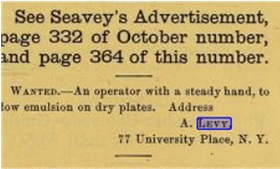
As a curiosity, we can find in the Philadelphia photographer - in the 1878 issue - a "wanted" ad asking for a "steady hand" to help him in the manufacturing process.