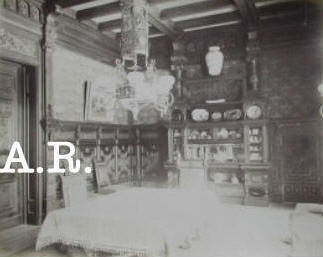
Find below the extracts from the letters Albert Levy wrote in the British Journal of Photography of 1904:
Letter 1: About hand cameras
Letter 2: teasing the editors regarding "psychic photography"
THE INFLUENCE OF THE CHEAP HAND CAMERA. To the Editors.
Gentlemen,—Do you not think it would be about time now to sound another tune from what we have been accustomed to hear lately? Nothing but praise has been heard, especially in the advertisement columns, about instantaneous or detective cameras. Without wanting to detract anything from their usefulness in some respects, and for some. purposes I think they have come to be looked upon as something universal, not to be improved upon. For portraits they are just the thing, and as good as any specially constructed camera and lens; for views nothing can excel them, always in focus giving depth and sharpness.
For architectural subjects, any child can, with one, take a cathedral or a castle, interiors, etc., just as well as any professional can do after years of experience. As for instantaneous views of railway trains, steamers, jumping horses, etc., who will admit that he has not done it or can do it at any time? The only difficulty is in getting the subject in the right place on the plate or film, but I think the party unable to do this is not born yet, or maybe he is dead long ago.
The fact is, however, that very few do really succeed with this instantaneous business, and the parties who have bought the outfits if they want to meet with good success and want to go on in that line, use a tripod and study their exposures, and then, after a little practice, get a larger and increasing percentage of good negatives. Experienced parties know very well that it is a very difficult matter to expose not only correctly but about correctly when one has to take views in a kinds of weather or wishes to take these views even when they a all exterior views in open air. And particularly so when one has two or three diaphrames in the lens, and exposures varying from 1/10. 1/100 of a second. reality. I have seen views with detective print it sounds all very well, but how different seen, and probably others also, individuals taking views with cameras in winter at 4 p.m., of a train passing another one will take in dark weather a "bus at full speed, and a cley party try his luck with one or two seconds exposure, camera in han on an old and dark painting in a room.
Who is to blame for this? This is a big question to answer. |course one can no say all this to a customer who wants to buy cheap or inexpensive outfit, and wants, after all, to spend as litt as possible generaly, and have a light camera containing all improvements possible and sometimes impossible.
The manufacturer wants sell and supply th retail dealer wane demand, let afterwards happen what may. also to sell as much as possible, and general knows more or less (rather less) about what he sells, says everything as easy as can be future a few extra receives his money, and says good-bye. Sells” films, some chemicals, sometimes develops a, certain quantity of failures, prints some foggy and out-of-focus. proofs, a that ends it for that party. I am not poor yet I am not rich, by how often I think, I only wish I had the one-hundredth part of 1] money that has been paid out for outfits which, after a very short tria have been discarded and put in the garret, if not in the cellar, to rot.
The fact remains that this demand which has been created | advertising such “good-for-everything,” detective, or other simil cameras, has spoiled the demand for good, real good, and usefportable cameras to be used with tripod, to such an extent that n only noimprovement on such is made, and the demand for the diminished, but th first-class firms, so mind that all thin time, and, as they se ope I see 100,the manufacture of them has been abandoned by son T have been told. Is photography really improving with such a state of things. I hay my doubts about it.
A few shillings, and maybe pounds, are mat by it, but in the end what will be the result? It should be bornegs pass, especially novelties. Everything has i say in France, “Un clou chasse l’autre.” The nel novelty will push this one (instantaneous boxes) in the shade, more ( ess, if not altogether. But not to go to extremes, let us admit th it will remain as it is now for say ten years more. What will be th result photographically? Large and fine photographs will not be see anywhere, «xcept as mere curiosities, and by large I do not speak «but probably as low as 10 x 8 or 84 x 6. Who nowadays willing to carry a camera as large as 64 x 44? Very fe indeed, and 34 x 4! is more commonly met with than anything large Result, an army of pigmy photos. There could be a possible salvagPp enlarged, at least Mighty few, and exposed, or under deducted. Of c different distances,int somewhere if these views would be sharp in focus, and could} to 10 x 8, but how many will stand this trial these lessened yet when the foggy ones, ove -exposed ones, out of focus or out of range, al ourse all modern cameras have lines marked fe but these are not marked with each lens as the should be, every lens having a different focus (if not, why ask 10s. mol or less for pairing stereos). Supposing this marking to be correct, whet is the man that can say exactly straight in front of him ten yards from twelve or eleven, or, better yet, twenty to thirty.
Then, where sharp focus for enlargements. Supposing that this is judged correct] (a first-class instrument being used of course) taking now, for instance, rather high building. How can the tilting of the back be judge correctly by the finders and kept so for exposure. In this case this many things to be more troublesome certain of a good a: looked at to get the picture just right is certain! than the use of a light tripod to make sure am nd first-class picture. We all have seen the beautful results that can be obtained by any one (even by animals allowed to press this e button) with So-and-so’s cheap outfit of only a few shillings, and you can start and have equally good results. And $01 is. The proof of it are the pictures shown you, and which have variably been taken with an outfit similar, and just by chance by a: 1 amateur on his first outing, developed and printed by himself, and whhas graciously offer:red it. You don’t doubt this. Do you? It nevér. . if enters your mind that this or these views shown to you as beginner results may have been made with another camera, and another lens, on tripod, by a good operator. No it does not, and it must not, as 11 not the case. Amen! But supposing you do not succeed as we samples shown, who is to blame but you. You may not think so,
Don’t know better to answer not being acquainted enough with photography and its tours de batons and try and improve , or, as I before, put the whole thing aside. The moral of this should be, everything in its place, and for special work use special cameras. Instataneous cameras are very good for special purposes and results wanted, they are not a cannot be universal. If yo want good instantaneous views of moving subjects, then an instantaneous camera is a necessity , however not necessarily without a tripod. But if you want landscapes and seascapes from shore, buildings, interiors the a regular camera with bellows and variable focus in certainly the superior to the former. I may even add that it is much easier to use a regular camera, swing back and rising front and a finder, all it can be made with ani instantaneous camera than the reverse.
your very truly
Albert Levy Asnières Seine. April 7 1904
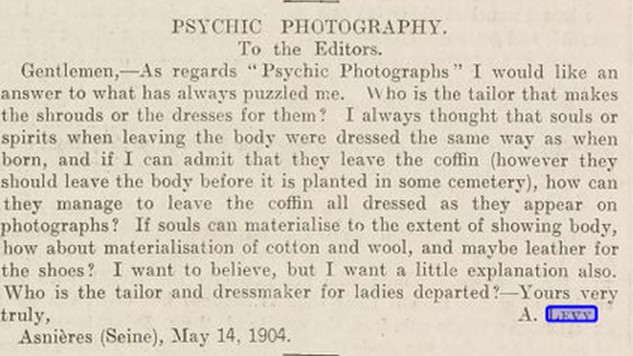
PSYCHIC PHOTOGRAPHY. To the Editors.
Gentlemen,—As regards “Psychic Photographs” I would like an answer to what has always puzzled me. Who is the tailor that makes the shrouds or the dresses for them? I always thought that souls or spirits when leaving the body were dressed the same way as when born, and. if I can admit that they leave the coffin (however they should leave the body before it is planted in some cemetery), how can they manage to leave the coffin all dressed as they appear on photographs?
If souls can materialise to the extent of showing body, how about materialisation of cotton and wool, and maybe leather for the shoes? I want to believe, but I want a little explanation also. Who is the tailor and dressmaker for ladies departed?—
Yours very truly, A. Levy.
Asniéres (Seine), May 14, 1904.